VPSA
Low pressure in. Vacuum out.
Filtered airmodest pressure
Zeolite bednitrogen retained
Oxygenboost if needed
Vacuum lowers the regeneration pressure below atmosphere, expanding the working pressure swing without high feed-air compression.

VPSA vs PSA oxygen generation
Vacuum Pressure Swing Adsorption (VPSA) and Pressure Swing Adsorption (PSA) both separate oxygen from air with adsorbent beds. VPSA adds vacuum to regenerate those beds while keeping feed-air pressure comparatively low. For sustained industrial demand, that difference can change energy use, equipment duty, and lifecycle cost.
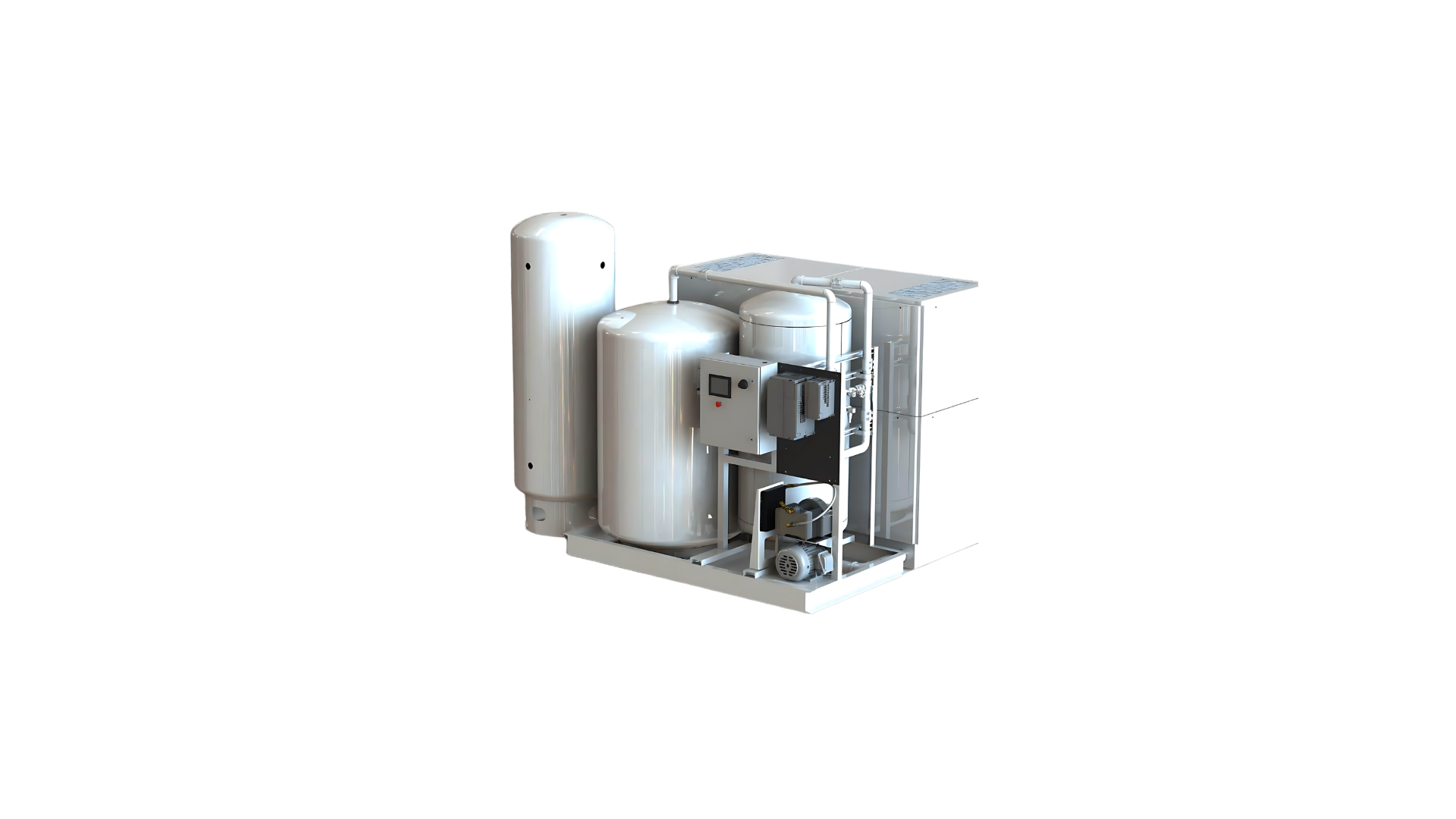
The direct answer
You do not need to know the acronym to make a sound decision. Start with the amount of oxygen your process needs, how steadily it needs it, and the pressure required at the use point. The technology should follow that basis—not lead it.
VPSA
Vacuum lowers the regeneration pressure below atmosphere, expanding the working pressure swing without high feed-air compression.
PSA
Regeneration lowers the bed toward atmospheric pressure, often with an oxygen-rich purge, before the next adsorption step.
Why the distinction matters
Air is mostly not oxygen.
Roughly four-fifths of ambient air is nitrogen and other gases. A conventional PSA approach compresses the full feed-air stream to a higher pressure before separating it. VPSA uses a smaller feed-air pressure rise and vacuum regeneration; when higher delivery pressure is needed, the much smaller oxygen product stream is boosted. That is the engineering reason VPSA can be compelling at steady industrial flow.
Where VPSA earns attention
VPSA is not a badge or a purity shortcut. Its value comes from matching the pressure cycle and equipment train to a defined oxygen duty.
A low-pressure blower moves the large feed-air stream; vacuum provides the regeneration swing. This can reduce specific power at sustained flow.
VPSA often becomes more attractive when oxygen is a steady production utility rather than an occasional packaged-gas requirement.
Product boosting can be selected around the actual use-point pressure instead of raising the full incoming air stream to that pressure.
Blowers, vacuum equipment, valves, and any booster replace the high-pressure feed compressor and dryer architecture typical of PSA.
VPSA often moves forward when...
PSA may remain sensible when...
Technical comparison
These are typical tendencies, not catalogue guarantees. Ask every supplier to state the boundary conditions behind its proposal.
| Factor | VPSAPressure + vacuum swing | PSAPressure swing | What to verify |
|---|---|---|---|
| How nitrogen is removed | Filtered air enters at modest positive pressure. Vacuum then lowers the bed below atmospheric pressure to release the adsorbed nitrogen. | Compressed air enters at higher pressure. The bed is regenerated by lowering its pressure toward atmospheric pressure, often with an oxygen-rich purge. | Same separation principle; different pressure strategy. |
| Main air-handling equipment | A low-pressure blower and vacuum equipment move the feed air and regenerate the adsorbent beds. | An air compressor, air treatment equipment, and cycling valves provide the higher-pressure feed air. | Compare the complete equipment train, not only the adsorber. |
| Product oxygen pressure | Oxygen commonly leaves the separation stage at lower pressure. A product booster is added when the process requires more pressure. | Oxygen commonly leaves the generator at a higher pressure that may suit some direct-use or distribution requirements. | Required delivery pressure can materially change the energy comparison. |
| Energy at sustained demand | The smaller pressure rise applied to the full feed-air stream can reduce specific power at steady, higher flows. | Higher feed-air compression can use more power, although avoiding a separate product booster may offset part of that duty. | Compare guaranteed kWh per unit of oxygen at the same flow, purity, and delivery pressure. |
| Typical project fit | Often attractive for continuous industrial demand where lifecycle power and operating strategy carry significant weight. | Often attractive for smaller packaged duties or where higher outlet pressure and broad service familiarity are priorities. | There is no responsible universal size cutoff. |
| Oxygen concentration | Single-stage adsorption systems commonly produce oxygen in the low-to-mid 90% range, depending on design and conditions. | Single-stage adsorption systems commonly produce a similar oxygen concentration range, depending on design and conditions. | VPSA versus PSA does not, by itself, determine purity. |
| Moisture and air preparation | Lower feed pressure changes the condensate and pretreatment duty, but inlet air still must be filtered and conditioned for the design. | Higher compression can create more condensate and normally requires a defined filtration and drying arrangement. | Neither technology makes inlet-air quality optional. |
| Maintenance focus | Service planning centres on blowers, vacuum equipment, valves, instrumentation, and any product booster. | Service planning centres on the feed-air compressor, dryer and filters, valves, instrumentation, and adsorber system. | Ask for intervals, spares, labour assumptions, and local support for the quoted configuration. |
| Site and ambient conditions | Altitude, temperature, humidity, dust, utilities, and turndown all belong in the design basis. | The same site conditions affect compressor capacity, pretreatment, recovery, cooling, and system output. | Both technologies must be rated for the actual site—not a sea-level catalogue condition. |
VPSA
Filtered air enters at modest positive pressure. Vacuum then lowers the bed below atmospheric pressure to release the adsorbed nitrogen.
PSA
Compressed air enters at higher pressure. The bed is regenerated by lowering its pressure toward atmospheric pressure, often with an oxygen-rich purge.
What to verify
Same separation principle; different pressure strategy.
VPSA
A low-pressure blower and vacuum equipment move the feed air and regenerate the adsorbent beds.
PSA
An air compressor, air treatment equipment, and cycling valves provide the higher-pressure feed air.
What to verify
Compare the complete equipment train, not only the adsorber.
VPSA
Oxygen commonly leaves the separation stage at lower pressure. A product booster is added when the process requires more pressure.
PSA
Oxygen commonly leaves the generator at a higher pressure that may suit some direct-use or distribution requirements.
What to verify
Required delivery pressure can materially change the energy comparison.
VPSA
The smaller pressure rise applied to the full feed-air stream can reduce specific power at steady, higher flows.
PSA
Higher feed-air compression can use more power, although avoiding a separate product booster may offset part of that duty.
What to verify
Compare guaranteed kWh per unit of oxygen at the same flow, purity, and delivery pressure.
VPSA
Often attractive for continuous industrial demand where lifecycle power and operating strategy carry significant weight.
PSA
Often attractive for smaller packaged duties or where higher outlet pressure and broad service familiarity are priorities.
What to verify
There is no responsible universal size cutoff.
VPSA
Single-stage adsorption systems commonly produce oxygen in the low-to-mid 90% range, depending on design and conditions.
PSA
Single-stage adsorption systems commonly produce a similar oxygen concentration range, depending on design and conditions.
What to verify
VPSA versus PSA does not, by itself, determine purity.
VPSA
Lower feed pressure changes the condensate and pretreatment duty, but inlet air still must be filtered and conditioned for the design.
PSA
Higher compression can create more condensate and normally requires a defined filtration and drying arrangement.
What to verify
Neither technology makes inlet-air quality optional.
VPSA
Service planning centres on blowers, vacuum equipment, valves, instrumentation, and any product booster.
PSA
Service planning centres on the feed-air compressor, dryer and filters, valves, instrumentation, and adsorber system.
What to verify
Ask for intervals, spares, labour assumptions, and local support for the quoted configuration.
VPSA
Altitude, temperature, humidity, dust, utilities, and turndown all belong in the design basis.
PSA
The same site conditions affect compressor capacity, pretreatment, recovery, cooling, and system output.
What to verify
Both technologies must be rated for the actual site—not a sea-level catalogue condition.
Project fit
The six inputs below determine whether a VPSA advantage is likely to survive real-world pressure, climate, redundancy, and operating requirements.
Average, peak, minimum, operating hours, seasonal pattern, and growth—not one headline capacity.
The process requirement and acceptable variation, including how concentration is measured and alarmed.
Pressure at the generator, receiver, distribution system, and actual use point, including line losses.
Altitude, design temperature, humidity, dust, ventilation, cooling, and hazardous-area constraints.
Redundancy, storage, delivered backup, maintenance windows, restart behavior, and failure response.
Electrical supply, demand charges, energy price, cooling, footprint, installation, and lifecycle horizon.
The comparison request that exposes weak proposals
Require kWh per Nm³, scf, or tonne of oxygen at the same concentration, average and peak flow, ambient condition, turndown, and delivery pressure. Include dryers, cooling, vacuum equipment, product boosters, and auxiliaries. A nameplate motor sum and a separation-stage estimate are not the same as expected system consumption.
A complete evaluation also records
Why Benchmark Oxygen Solutions
OSI focuses on VPSA because many of the applications we serve need oxygen as a dependable, sustained process utility. We begin with the duty and engineer the pressure strategy, controls, storage, backup, and service plan around it.
OSI VPSA systemFlow, concentration, pressure, schedule, site conditions, and continuity define the system—not a preselected model.
Generation is coordinated with product pressure, receiving, controls, backup, utilities, and process integration.
We put power, maintenance, operating conditions, and support expectations on the same stated basis.
If the project basis does not support VPSA, the right next step is to say so before equipment is specified.
Industrial applications
The oxygen requirement is different in every process. These application pages show the questions that should accompany any VPSA or PSA discussion.
Define oxygen duty against the process objective, operating schedule, altitude, and continuity plan.
Review application questionsConnect oxygen generation to treatment load, transfer equipment, turndown, controls, and backup.
Review application questionsPlan steady demand, peak events, phased growth, distribution, alarms, and stored or redundant supply.
Review application questionsMatch oxygen flow and pressure to the defined mill process, utility basis, integration scope, and uptime need.
Review application questionsCoordinate the oxygen plant with the treatment specialist, use-point conditions, controls, and operating profile.
Review application questionsFrequently asked questions
No. VPSA is often a strong fit for sustained, higher-volume industrial demand because it can reduce the pressure work applied to the full feed-air stream. PSA can remain a practical choice for smaller packaged duties, intermittent demand, or projects that benefit from higher oxygen pressure directly from the generator. The comparison must use the same flow, purity, delivery pressure, ambient conditions, and operating schedule.
Both use adsorbent beds—commonly zeolite—to retain nitrogen while oxygen passes through. PSA adsorbs at higher pressure and regenerates by depressurizing toward atmospheric pressure. VPSA uses modest positive pressure for adsorption and vacuum below atmospheric pressure for regeneration.
Not inherently. Single-stage zeolite adsorption systems commonly produce oxygen in the low-to-mid 90% concentration range. Purity depends on the adsorbent, cycle design, operating conditions, controls, and required recovery—not simply whether the label says VPSA or PSA.
VPSA can avoid compressing the entire incoming air stream to the higher pressure commonly used by PSA. The feed air sees a smaller pressure rise, while only the product oxygen needs additional compression when the process requires higher delivery pressure. The actual advantage depends on flow, efficiency, vacuum level, booster duty, turndown, and site conditions.
Often, yes, when the downstream process or distribution system requires pressure above the VPSA separation-stage outlet. A fair proposal should include that booster and its energy, maintenance, redundancy, and control requirements.
The terms are sometimes used loosely. VSA generally describes a cycle that adsorbs near atmospheric pressure and regenerates under vacuum. VPSA more precisely describes a cycle that operates above atmospheric pressure during adsorption and below atmospheric pressure during regeneration. OSI specializes in pressure-vacuum cycle configurations and uses VPSA as the public term.
At minimum: average and peak oxygen flow, operating hours, required concentration, required delivery pressure, ambient temperature and altitude, humidity and dust conditions, electricity supply and price, turndown, redundancy, storage, maintenance expectations, and the project evaluation period.
Technical basis
This page separates broadly supported engineering principles from project-specific outcomes. Published studies demonstrate that VPSA can outperform PSA in defined cases; they do not justify a universal savings percentage for every site.
Silica-alumina zeolite adsorbents for oxygen generation via pressure swing adsorption
Chemical Engineering Journal, 2024 — review of PSA, VSA, and VPSA mechanisms and operating conditions.
Comparative performance of industrial-scale PSA and VPSA under plateau conditions
Adsorption, 2023 — a project-specific experimental comparison demonstrating why site conditions and cycle design matter.
PSA, VPSA, and VSA Oxygen Generation Technologies
External PDF — The Global Fund technical briefing on equipment, pressure, benefits, and drawbacks using a common comparison basis.
Energy Consumption of PSA vs. VSA — A Thermodynamic Study
Benchmark Oxygen Solutions technical note — one stated production and delivery-pressure scenario, not a universal savings claim.
External sources are provided for technical context. Their inclusion does not imply endorsement of Benchmark Oxygen Solutions or its products.
Technical note: actual oxygen output, concentration, recovery, specific power, outlet pressure, maintenance, and cost depend on the quoted equipment and boundary conditions. Final selection requires supplier data and project engineering review.
Share your flow, purity, pressure, operating schedule, site conditions, and continuity needs. OSI will help determine whether VPSA deserves the next level of engineering review.